High latency and loading failures for sites accessed from China

Performance

Latency turns traffic into abandonment.

Long round-trips and incomplete pages mean real users never see your content—most leave before anything usable renders on a China network path.

See the pain points
Ecosystem silos: global APIs and embeds break in China

Ecosystem

Silos break your stack before users arrive.

Google Maps, YouTube embeds, and global APIs often fail or vanish behind the firewall—your polished site ships with broken endpoints and unreachable dependencies.

Explore solutions
Regulatory maze: ICP, filings, and compliance in China

Compliance

Regulation is a maze— not a footnote.

ICP filings, review cycles, data rules, and sector limits decide whether you can operate at all—we help you navigate filings and local requirements with clarity.

Run the free 10-point check

Global China

China hosting, ICP compliance & WeChat integration for global brands

Chinagateway.pro is a technical bridge for companies entering mainland China. We fix slow cross-border sites, replace blocked global APIs, and guide ICP filing and ecosystem work—so your product is fast, legal, and usable on China networks.

In one sentence

We help global brands deploy compliant, high-performance digital products in China through mainland infrastructure, regulatory navigation, and WeChat-native payments and mini programs.

Key takeaways
  • Mainland hosting and CDN cut load times from 30+ seconds to a usable experience.
  • ICP filing and entity setup reduce risk of domain blocking and enforcement action.
  • Localized maps, video, auth, and WeChat Pay replace APIs that fail behind the firewall.

See the pain points →

Challenges

Is your digital presence
failing in China?

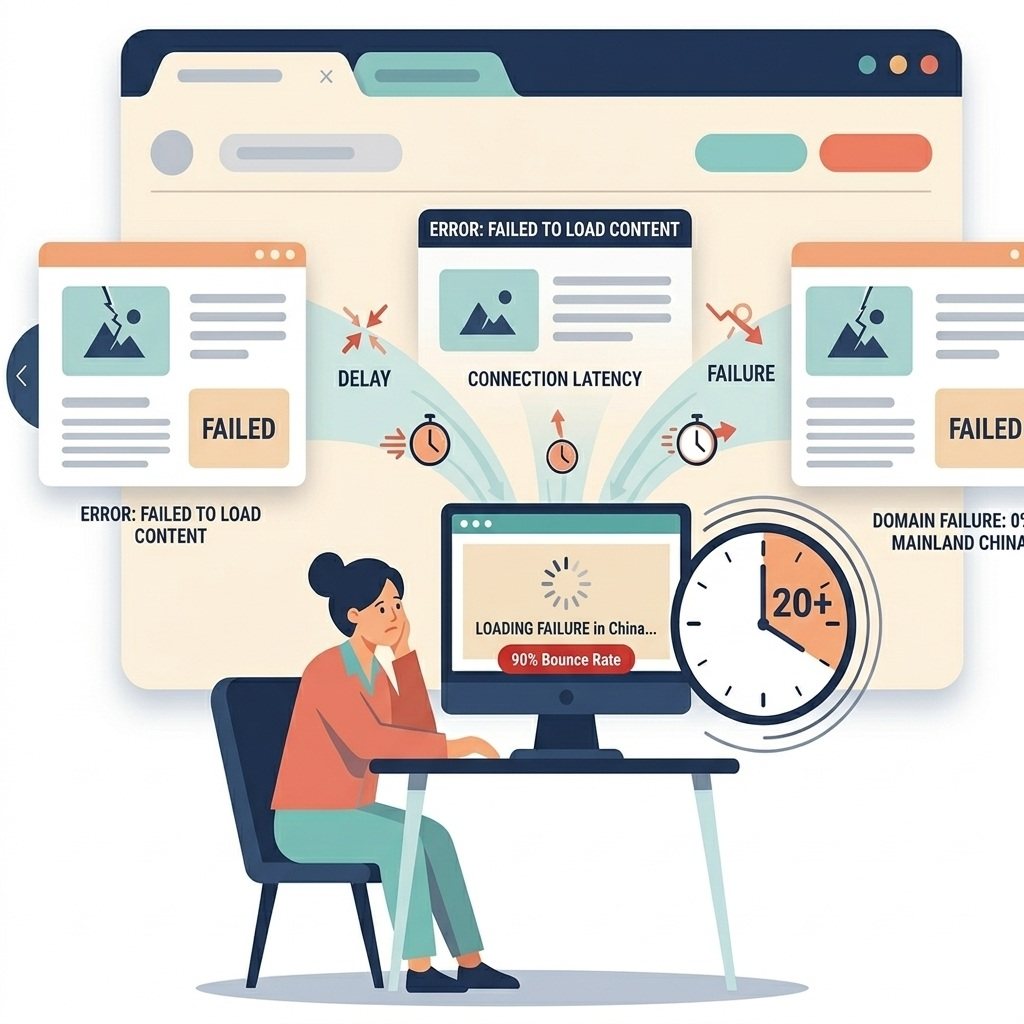
Website loading slowly on a China network path

"It's too slow."

Your global website takes 15–30+ seconds to load in mainland China, causing users to bounce before the first pixel appears.
How we fix slow →

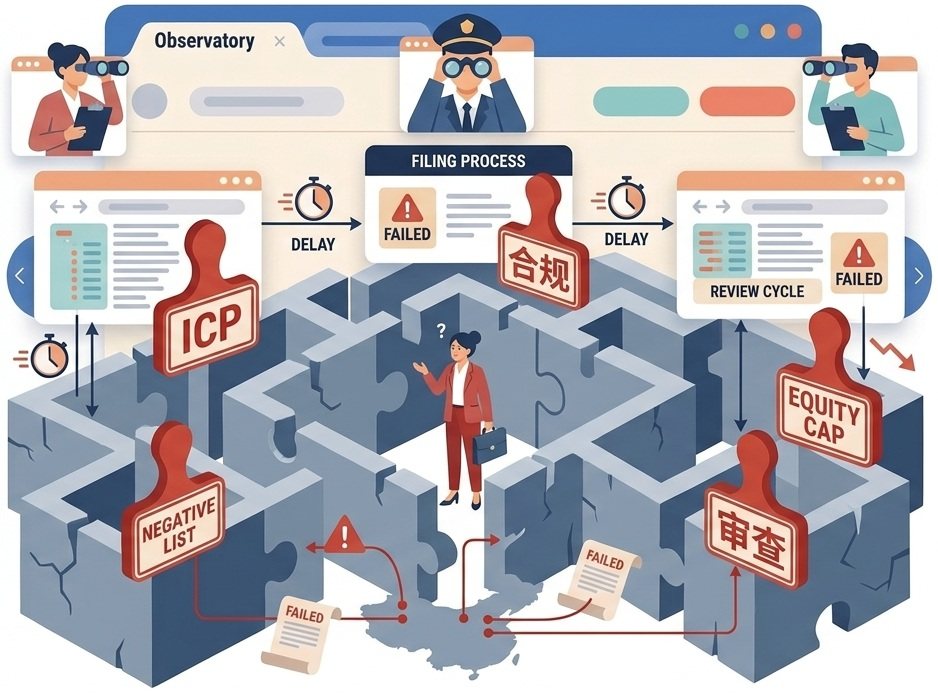
Legal and regulatory requirements for operating a site in mainland China

"Is it legal?"

Operating without an ICP license or localized data privacy strategy puts your brand at constant risk of domain blocking.
How we make it legal →

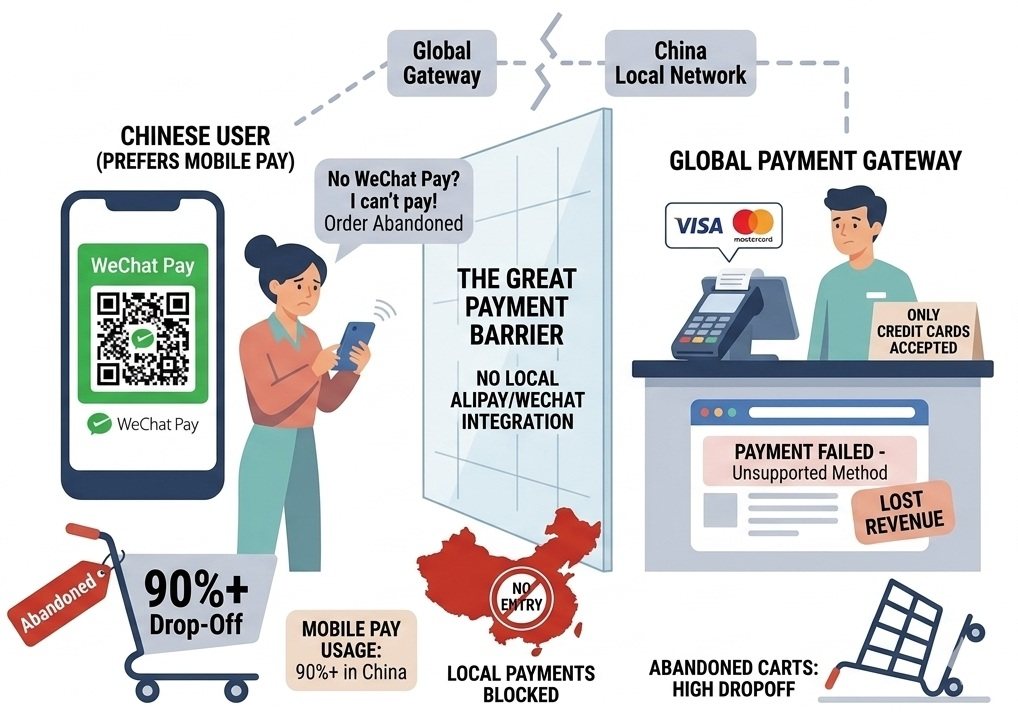
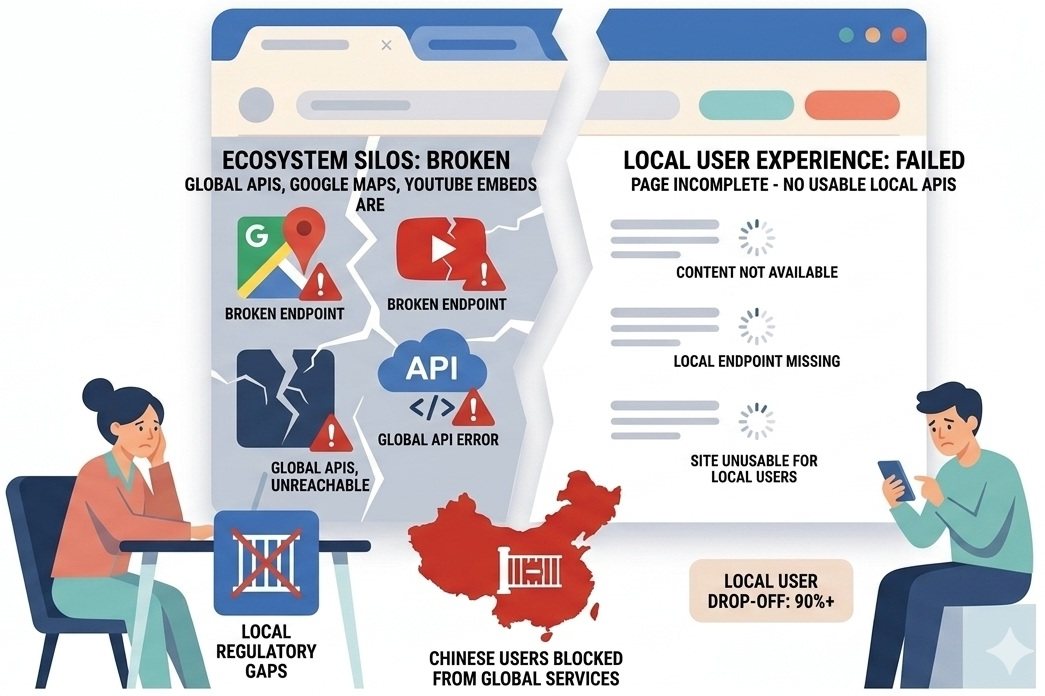
Third-party APIs and embeds that fail behind the China firewall

"Links are broken."

Google Maps, YouTube, and Global APIs are inaccessible, rendering your sophisticated web features completely useless.

How we fix broken links →

Who we serve

Global teams shipping digital products to mainland China

If these challenges sound familiar, we typically help the following teams enter and operate in China.

SaaS & B2B

Cross-border apps, dashboards, and APIs that must load reliably for China-based customers.

E-commerce & D2C

Storefronts needing speed, compliance, and WeChat-native conversion paths.

Fintech & regulated

Data residency, filings, and audit-ready architecture before go-live.

Enterprise

Corporate sites and partner portals across HQ and China subsidiaries.

Not sure where you fit? Run the free 10-point check — it maps your stack, dependencies, and compliance gaps.

Free tools

Eight self-serve tools. No signup.

The same no-signup assets we use on engagements — run them yourself, and trace every fact to the source registry.

China readiness diagnostic

A 10-point yes/no checklist you score yourself — no signup, no email.

Where you stand on mainland speed, blocked dependencies, WeChat Pay, and ICP gaps.

Run the free check →

ICP timeline estimator

Answer three inputs; get your gating phase and an ordered filing checklist.

Which step gates your launch — entity, filing, or license — and what comes first.

Estimate your timeline →

WeChat Pay path selector

Select entity type, sales surface, and settlement currency.

The WeChat Pay acceptance path that fits your setup — and how funds settle.

Find your acceptance path →

Hosting cost worksheet

A scenario worksheet built from documented vendor examples — not quotes.

How mainland, hybrid, and offshore-only setups compare, using only published vendor figures.

Compare scenarios →

China launch sequencing map

A static planner: the serial chain from entity to merchant onboarding, with parallel tracks marked.

What must wait for the ICP filing — and what can run in parallel.

Map your launch order →

Source registry

The 89 primary sources behind every regulatory and vendor fact on this site.

The exact URL, the claim it supports, our access date, and its live status.

Browse the registry →

China dependency checker

A filterable status table of the blocked third-party dependencies — Maps, Video, Fonts, reCAPTCHA, Firebase, Payments.

Each row: the China verdict, the replacement path, and the deep-dive link.

Check your dependencies →

China obligations matrix

Six launch instruments — filings, licenses, platform bindings — mapped to the party that holds each.

What the brand controls vs what the operator handles, and where each identifier surfaces.

Map who holds what →

Three layers of a China launch

Mainland infrastructure, ICP filing and compliance, and WeChat ecosystem development — scoped, sequenced, and delivered on your codebase.

Infrastructure: mainland cloud hosting, CDN, and routing optimization

Infrastructure &
Optimization

Native mainland hosting on Alibaba Cloud & Tencent. Specialized CDN and routing solutions for superior speed behind the Great Firewall.

Learn more about infrastructure →

Cloud • Acceleration • SEO
Legal entry: entity setup, ICP filing, and compliance

Legal Entry &
Compliance

Assisting with local entity setup (WFOE) and managing end-to-end ICP Filing (Bei’an) processes for a compliant digital presence.

Learn more about ICP & compliance →

Entity Setup • ICP Licensing
Ecosystem: mini programs, mobile payments, and localized security

Ecosystem
Development

Full-stack WeChat Mini Program development, WeChat Pay integration, and localized technical security to match the unique China landscape.

Learn more about WeChat ecosystem →
WeChat • Mobile Pay • Security

How we work

From audit to production in four phases

A structured path from first call to mainland launch—with clear owners, milestones, and deliverables at each step.

  1. Discovery & audit

    Map your stack, China traffic paths, blocked dependencies, and compliance gaps. Run the 10-point self-check first.

    • Stack map
    • Risk report
  2. Architecture & compliance

    Define hosting, CDN, entity/ICP route, and API replacements with clear timelines.

    • ICP roadmap
    • Arch diagram
  3. Build & integrate

    Implement infrastructure, filings support, and WeChat integrations on your codebase.

    • CDN & hosting
    • WeChat dev
  4. Launch & optimize

    Monitor performance from China networks and hand over runbooks for operations.

    • Go-live
    • Runbooks

FAQ

Common questions about China digital entry

Do foreign companies need an ICP license to operate a website in China?

Most sites served in mainland China require ICP filing (Bei'an) or an ICP license for commercial platforms. ICP guide

How long does ICP filing typically take?

With complete documents, filing often takes 2–4 weeks, varying by province and business category.

Can we keep our global website and only optimize for China?

Yes—many brands add a China path with CDN, localized pages, and replaced APIs. Infrastructure options

Why is my global website slow in mainland China?

Cross-border latency and blocked scripts often cause 15–30+ second load times. Mainland CDN and hosting help. Full diagnosis · Run the 10-point check

Do Google Maps, YouTube, and global APIs work in China?

Many Western services are blocked or unreliable. Use Amap/Baidu Maps, domestic video hosts, and China-accessible payments. Full playbook · Check your site

What is the difference between ICP filing and an ICP license?

ICP filing is mandatory for most mainland-hosted sites. An ICP license is required for commercial online platforms. Full comparison

Do I need a WeChat Mini Program to sell in China?

Not always, but Mini Programs and WeChat Pay are often essential. WeChat services · Mini Program vs H5 vs app

Which cloud providers do you use in mainland China?

We implement on Alibaba Cloud and Tencent Cloud, chosen for your stack and compliance needs.

All 20 questions with full-article links: China Market Entry FAQ

Glossary

China market entry terms

ICP filing (Bei'an)
Mandatory registration for most mainland-hosted websites.
ICP license
Permit for commercial online platforms and paid services.
WFOE
Wholly Foreign-Owned Enterprise—a common entity for ICP and local ops.
Mainland CDN
Edge caching on China networks to cut cross-border latency.
WeChat Mini Program
Lightweight app inside WeChat for commerce and campaigns.
Great Firewall
Colloquial term for China's internet filtering of global services.
CN2 / CMI Transit
The carrier paths your traffic rides — the invisible variable in every China speed test.
MIIT
The ministry whose systems run mainland filing verification and licensing.
PSB filing
Public-security (police) filing that follows the ICP filing number.
CDN license
The MIIT-issued permit to operate CDN services in mainland China.
WeChat Pay merchant
The merchant account on pay.weixin.qq.com that binds checkout to your APPID.
PIPL
China's personal-data law — reaches offshore sites targeting mainland users.
APP filing
The ICP registration for native apps on mainland-resolving backends.
H5 pay
WeChat Pay checkout from a mobile web page — no Mini Program build.
WeChat Official Account
WeChat's publish-and-nurture layer — Service vs Subscription account types.
Cross-border settlement
Getting WeChat Pay funds from mainland buyers to your foreign bank account.
AWS China Regions
Amazon's mainland regions — Sinnet/NWCD operators, separate China account, same ICP filing gate.
Azure China (21Vianet)
Microsoft's cloud in mainland China — physically separated, operated by 21Vianet.
Data residency
Mainland-collected personal information stays on mainland servers for a defined class under PIPL.
Alipay vs WeChat Pay
Two separate acceptance agreements — which path your entity qualifies for, and when to accept both.
WeCom (WeChat Work)
Tencent's enterprise communication and office tool with full WeChat connectivity — the enterprise layer of the WeChat ecosystem.
VATS / EDI license (B21)
The MIIT value-added telecom permit family — B21 covers online transaction processing; 2024 pilot lifts the equity cap in four zones.
Weixin Open Platform
The developer portal that connects native mobile apps to WeChat — Share, Login, Pay, and UnionID.
Cross-border data transfer
The three PIPL Article 38 mechanisms — security assessment, SCC filing, certification — plus the 2024 exemption tiers.
CAC (Cyberspace Administration of China)
China's cyberspace regulator — the authority behind data-export Orders No.11, No.13, and No.16.
Data Security Law (DSL)
China's framework law for data processing — source of the "important data" trigger behind the cross-border security assessment.
ICP filing lookup
The public query of MIIT filing records at beian.miit.gov.cn — verify a vendor's filing number and its domains.
Cybersecurity Law (CSL)
China's foundational cybersecurity statute, in force since 2017-06-01; the 2025 amendment takes effect 2026-01-01.
Business license
The document a mainland-registered company holds; the WFOE's license enables the ICP filing.
UnionPay
The card-scheme layer beneath mainland wallets — cardholder acceptance in 183 countries and regions per UnionPay International.
SAFE
China's foreign-exchange regulator — the authority behind the 2019 Measures for payment institutions' cross-border FX business.
Sensitive personal information
The PIPL Article 28 data class — six statutory categories plus under-14s — gated by separate consent and tracked separately on the cross-border threshold ladder.
CIIO
The operator of designated critical information infrastructure under State Council Decree 745 — designation is regulator-notified, not self-declared.

Full definitions: China Digital Entry Glossary

Every China-regulatory and vendor fact on this site traces to a primary source: Source Registry

The dated instruments behind the filings, transfers, and platform gates on this site: China Digital Regulations Timeline